
Weapons and combat
Combat mixes melee and ranged: pipes, chains, plasma torches and bats from the store description, plus katanas, miniguns, EMP grenades and AK-47s named in official posts and launch reviews. No official damage numbers exist, so this page does not publish any.
Combat in Airframe Ultra is deliberately close and deliberately scrappy. The store description sells it as "thrash with pipes, chains and plasma torches" or "leave them in the dust with boosts and pure white-knuckle cunning" — a game where the fastest line and the biggest swing are both legitimate answers to the same problem.
No damage numbers are published for any weapon. What follows is what the store page, the official announcements and launch-week reviews actually name.
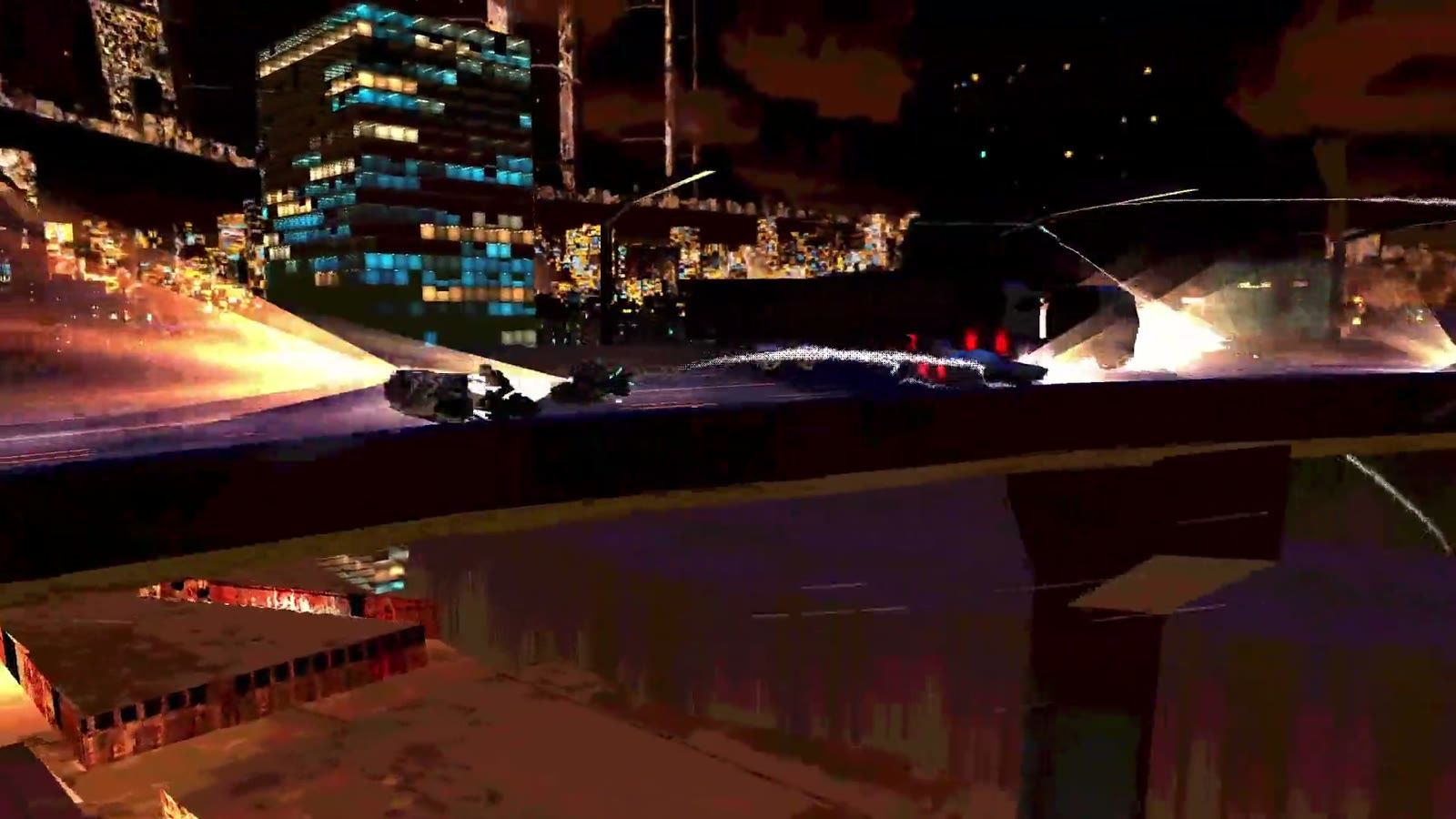
What the official material names
| Weapon | Where it is named | How it shows up in play |
|---|---|---|
| Pipe (bent pipe) | Store description ("pipes"); launch review | Cheap arena melee, the default answer early in a match |
| Chain | Store description | Melee reach; swings around the bike |
| Plasma torch | Store description | Named alongside pipes and chains as a thrash weapon |
| Baseball bat | Store description ("a big heavy baseball bat") | The story weapon — the thing a gutter kid owns |
| Katana | Official event post (Night Ride example) | Cited as a kill-streak weapon on that track |
| Minigun / Gatling | Official event post, launch review | Ranged; the review's example of stealing first place |
| EMP grenade | Launch review | Named among the purchasable weapons in the arena |
| AK-47 | Launch review | Named as the weapon that decides survival-race balance |
That last row is a reviewer's complaint, not a feature list: the same piece argues survival races are decided by whoever banked money and got the bigger gun. Read it as a description of how the economy feels in practice rather than as a balance verdict.
Melee, ranged, and why both exist
The design pillar Fast and Deadly is explicit that the game does not want you to specialise: "A good racer should be able to win games. A good killer should be able to win games." That has a mechanical consequence in the arena — you cannot win a circuit by being fast alone, because points come from both halves.
| Situation | Melee answer | Ranged answer |
|---|---|---|
| Someone parked on the objective | Close and swing | Hold distance and chip |
| You are on low cash | Free — you spawn with hands | Nothing to buy with |
| You need to break a chase | Swing into the pursuer's line | Turn and fire |
| You are about to lose first | Not applicable | Steal the position at the line |
The store page also mentions that you can fight off the bike. Walking is not the intended mode — one launch review describes on-foot handling as "like a tank" and says you have to hold a run button — but it exists, and the arena supports hand-to-hand combos in four directions.
The arena economy
Cash picked up during the sprint is the only currency that matters inside a circuit, and it converts into weapons during arena phases. That makes the sprint economically load-bearing: a clean lap that ignores pickups is worth less than a scrappy one that hoovers them.
Three practical consequences:
- Buy before you brawl. Cash in the wallet does nothing; a weapon in hand changes the fight.
- Weapons are per-arena, not per-career. Nothing in the official material describes a persistent arsenal carried between circuits, and the store frames the loop as sprint → arena → buy → next round.
- The bigger purchase is not always the right one. The reviewer's AK-47 complaint is really a statement that one weapon dominates; the counter is that you only get the cash for it if your sprint went well.
Damage and TTK: what is not published
There is no official damage table, no rate-of-fire list, and no time-to-kill figure for any weapon. Any site handing you "Gatling: 24 damage per shot" is making it up. What you can measure yourself, in the lobby:
- How many swings a full-health racer survives from a pipe.
- Whether a chain out-ranges a bat.
- What a minigun burst does to a bike versus a walking racer.
Those are worth writing down for yourself, because the balance pass cadence means they change. The October devlog commits to monthly balance patches and weekly bug triage, so a weapon that dominates in week one may not in week four. Check post-launch roadmap for the exact cadence the team published.
On-foot combat
Off the bike, combat is a four-direction punch-and-kick system with combo chaining. A launch review compares it to Oni, Bungie's 2001 action game, and lists Road Rash as the more obvious influence on the whole package. That is the clearest description of the melee feel available from a published source.
| On foot | On the bike |
|---|---|
| Four-direction melee, combo chains | Melee swings from the saddle |
| Slow movement, run button held | High speed, boost and airbrake |
| Best for contesting a pickups cluster | Best for chasing down a fleeing racer |
Building a fight plan
If you are losing arenas, the cause is usually upstream. Check, in order:
- Did you arrive with cash? No cash means no weapon, and no weapon means you are the fight.
- Are you fighting in the open? Arena cover favours the melee player; open ground favours ranged.
- Are you chasing kills instead of points? A kill that costs you the next sprint is a net loss.
- Are you still on the bike when you should be off it? On foot you turn faster and swing harder.
Once the basics are habit, the ceiling is the airbrake and the stars system — the two systems the developers say are meant to be discovered rather than taught. The achievements table is also a decent syllabus: ACH_FIVE_KILLS sits at 43.9%, which tells you most players never get five in a match.